IBAN Error Finder
An IBAN error finder is a tool that takes an IBAN a bank or a website has refused and says which specific rule it breaks: the country’s length, the country’s format, the ISO 13616 checksum, or the account number’s own check digit. Where the checksum is what failed, it also lists the single-character corrections that would make it valid. Everything runs in your browser.
Checked in your browser. The IBAN is never sent to us and never stored.
Sending money to another country?
Wise shows the exchange rate and its fee before you send.
Partner link. If you open a Wise account through it and send money between two currencies, Wise pays ibanchecker.cash a commission; what you pay does not change. How this works
Why is my IBAN not working?
There are four reasons an IBAN can be refused that are visible in the number itself, and they are checked in this order. The first two letters name the country, and the country decides everything after that: how long the IBAN is, and which positions hold letters and which hold digits. If the length or the pattern is wrong, the check digits are never even reached. If both are right, the two digits after the country code are verified with ISO 7064 MOD-97-10 arithmetic over the whole IBAN. And in many countries there is a further check digit inside the account number itself, set by the national banking system rather than by the IBAN standard, which this tool runs wherever the country defines one.
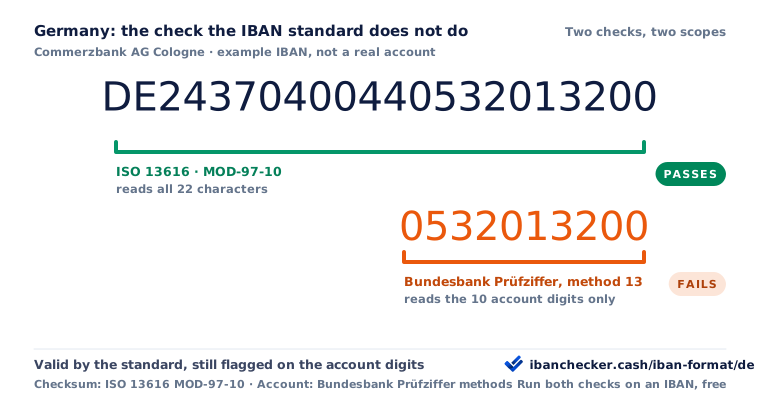
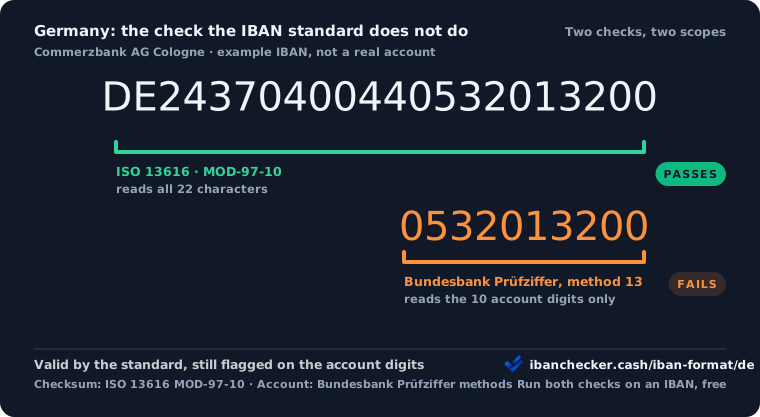
A fifth class of failure is not in the number at all. A perfectly valid IBAN is still refused when the account is closed, when the sender does not support that country or currency, when the name on the payment does not match the name on the account, or when the form wanted a BIC as well. No offline tool can see any of those, and any tool that claims otherwise is guessing.
What does “IBAN does not match expected format” mean?
It means the IBAN is not shaped the way its country requires. Length is fixed per country, from 15 characters in Norway to 33 in Russia, and so is the arrangement of letters and digits: a German IBAN carries digits only after the check digits, while a Dutch one puts four letters there for the bank. A form reporting this has compared what you pasted against the country in the first two letters and found one of those two rules broken. The country format reference shows the exact rule for all 92 IBAN countries.
What does “incorrect checksum” or “invalid check digit” mean?
The two digits straight after the country code are not part of the account number. They are a checksum over everything else in the IBAN, and they exist precisely to catch a mistyped character or two adjacent characters entered the wrong way round. When a form says the checksum is incorrect, the check is doing its job: something in the IBAN is not what the issuing bank wrote down. You can watch the arithmetic run, digit by digit, in the checksum verifier.
Why is my Revolut IBAN only 20 characters?
Because it is most likely a Lithuanian IBAN, and Lithuanian IBANs are 20 characters. Revolut Bank UAB is licensed in Lithuania, so many of its euro accounts carry an LT IBAN even when the account holder lives somewhere else entirely. A short IBAN is not a damaged one, and the same surprise catches people with Belgian accounts, which are shorter still at 16 characters. If the length matches the country in the first two letters, the length is right.
Why does one site reject an IBAN that another site accepts?
Because they are not running the same checks. The lightest implementations only verify the ISO 13616 checksum, which any structurally sound IBAN passes. Stricter ones also enforce the country’s length and format, refuse countries they do not pay at all, or go further and verify the national check digit buried inside the account number. That last check is the one that most often explains an IBAN accepted in one place and refused in another, and it is the one this tool runs for you.
What this tool cannot tell you
It cannot tell you the correct IBAN, and neither can anything else that only sees the number. When the checksum fails, it searches every IBAN one keystroke away and lists the ones that would be valid, putting first those whose bank code resolves to a real institution and whose national check digit holds. Tested against 220 real IBANs damaged by a single keystroke, the original was recovered every time, but it usually shared the list with about three others and occasionally with nineteen. That is the honest shape of the answer: the tool narrows the field, the account holder confirms it.
It also cannot tell you whether the account exists, whether it is open, or whether it belongs to the person you are paying. That last question is what Verification of Payee answers, and only the account’s own bank can answer it. For the longer written walkthrough of every common IBAN mistake, see the invalid IBAN error guide.